Understanding the Difference Between 2.1 and 2.2 Degrees
londonde
September 30th, 2025
Introduction
Graduating with a 2.2 instead of a 2.1 could cost you your dream job—even if you’re just a few percentage points away. Many students don’t realize how these seemingly small grade boundaries create massive differences in career opportunities, postgraduate admissions, and earning potential. Understanding the difference between 2.1 and 2.2 degrees isn’t just about knowing grade ranges; it’s about strategic academic planning that can transform your professional trajectory and unlock doors that might otherwise remain closed.
What Are 2.1 and 2.2 Degrees?
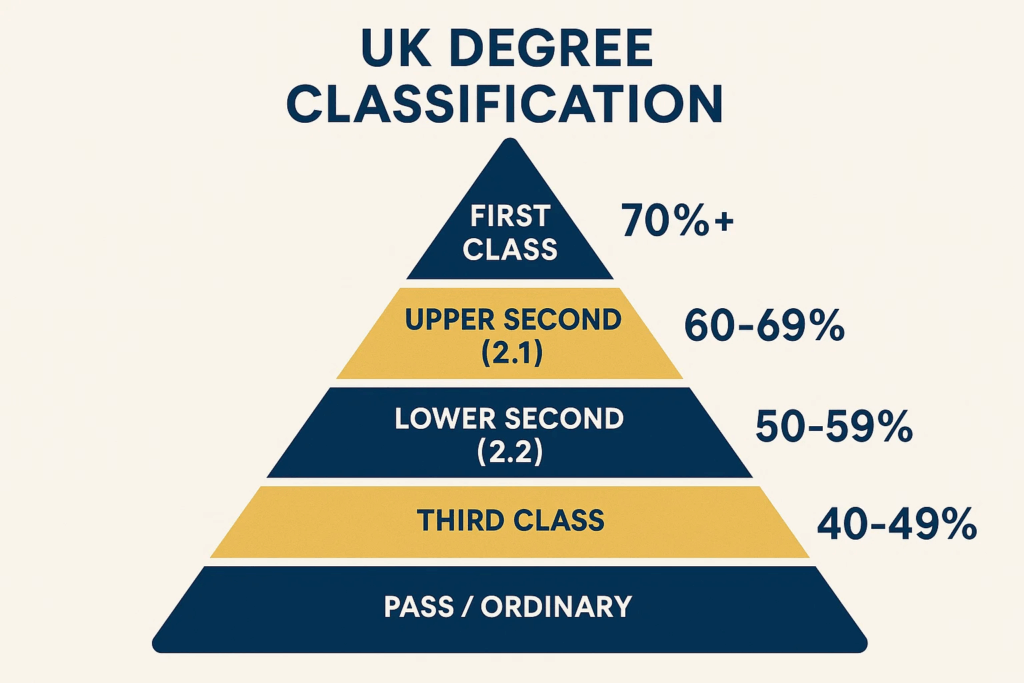
In the United Kingdom’s degree classification system, both 2.1 (upper second-class honours) and 2.2 (lower second-class honours) fall under the category of second class honours degrees. These classifications represent the middle tier of undergraduate achievement and are the most commonly awarded degree classes in British universities.
A 2.1 degree (pronounced “two-one”) represents strong academic performance and is considered the standard benchmark for graduate employment and further study. A 2.2 degree (pronounced “two-two”) indicates satisfactory academic achievement but may present additional challenges in competitive job markets and postgraduate applications.
Both classifications demonstrate that you’ve completed your bachelor’s degree with honours, distinguishing you from those who achieve only a pass degree. However, the practical implications of these two grades differ significantly in real-world applications.
The fundamental difference between 2.1 and 2.2 degrees lies in the percentage boundary: just 10 percentage points separate these classifications. However, this numerical difference translates into substantial qualitative distinctions:
2.1 Degree Characteristics:
Demonstrates strong understanding of subject matter
Shows ability to analyze complex concepts critically
Reflects consistent high-quality work throughout the degree
Indicates research skills and independent thinking
Suggests readiness for professional or academic advancement
2.2 Degree Characteristics:
Shows competent understanding of core concepts
Demonstrates satisfactory completion of degree requirements
Reflects adequate but not outstanding academic performance
May indicate inconsistent performance across modules
Suggests need for additional development in some areas
Perception in Higher Education
Universities and academic institutions view these classifications differently when considering applicants for postgraduate programs. Most master’s programs require a minimum 2.1 for admission, particularly for competitive courses in business, law, medicine, and engineering.
Demonstrate relevant work experience (2-5 years typically)
Complete a pre-master’s or conversion course
Provide compelling personal statements explaining circumstances
Show evidence of improvement in final year modules
Obtain strong professional references
Grade Boundaries and Percentage Requirements
Percentage Breakdown
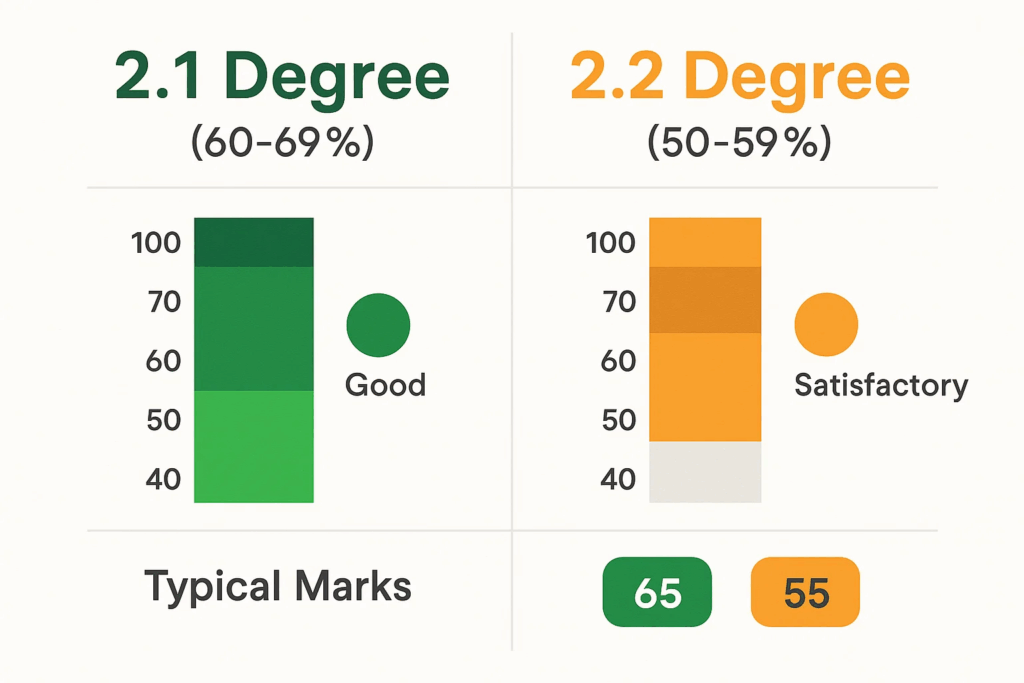
Understanding the precise grade boundaries helps students strategize their academic efforts:
Degree Class
Percentage Range
Grade Description
2.1 (Upper Second)
60-69%
Good to Very Good
2.2 (Lower Second)
50-59%
Satisfactory to Good
How Final Grades Are Calculated
Most UK universities use a weighted average system where:
Year 1: Often worth 0-10% (foundation year)
Year 2: Typically worth 20-40%
Year 3: Usually worth 60-80% (final year)
This weighting means that improving performance in your final year can significantly impact your overall classification. Students who achieve 2.2 grades in their second year can still graduate with a 2.1 if they perform strongly in their final year.
Module Performance Impact
Your degree classification depends on cumulative performance across all modules. Universities typically use one of these calculation methods:
Straight Average: All modules weighted equally
Credit-Weighted Average: Modules weighted by credit value
Best Modules: Top-performing modules count more heavily
Borderline Consideration: Manual review for students on classification boundaries
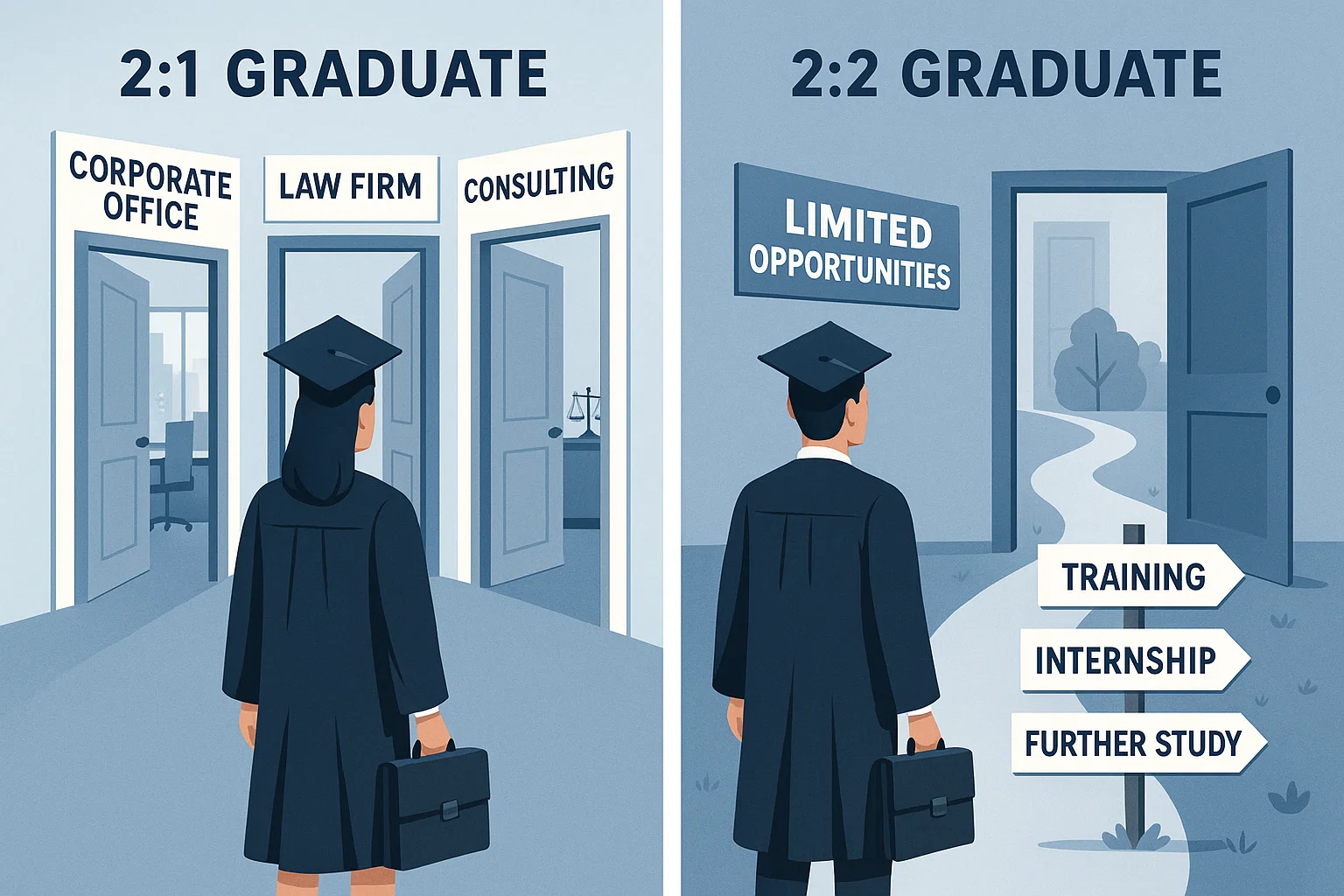
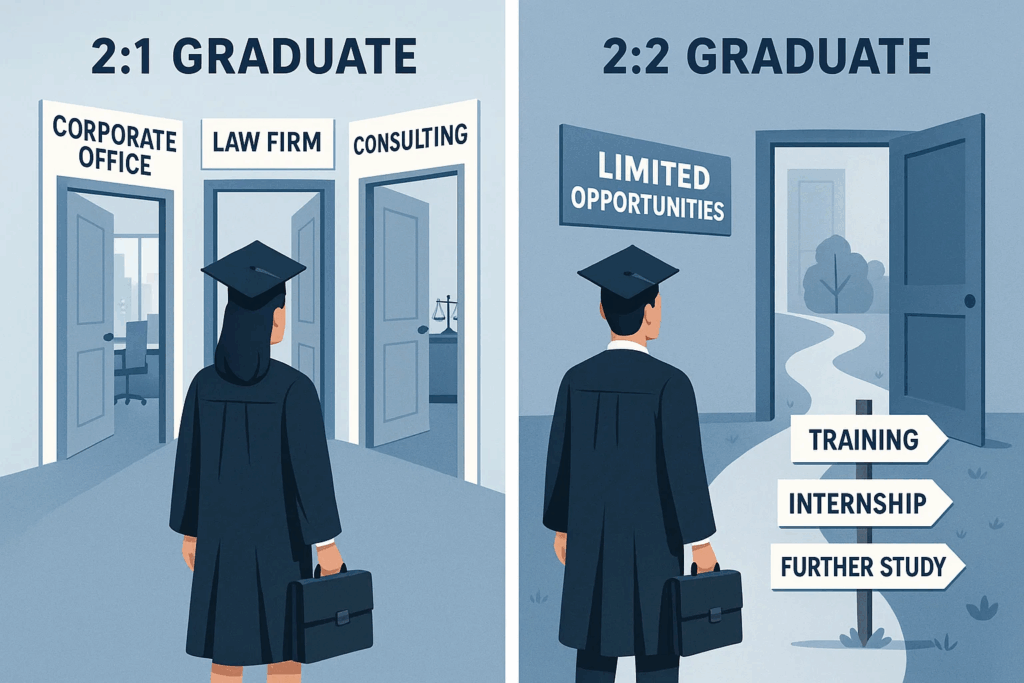
The difference between 2.1 and 2.2 degrees becomes starkly apparent in employment outcomes:
2.1 Graduates:
85-90% employed within 6 months of graduation
Access to graduate schemes at top employers
Average starting salary: £25,000-£32,000
Competitive advantage in application screening
Broader range of opportunities across sectors
2.2 Graduates:
75-80% employed within 6 months of graduation
Limited access to competitive graduate schemes
Average starting salary: £22,000-£28,000
May face initial screening barriers
Need stronger applications to compensate
Sectors Where Degree Class Matters Most
Some industries place greater emphasis on degree classification:
Highly Competitive (2.1 Usually Required):
Investment Banking and Finance
Management Consulting
Legal Sector (solicitor training)
Accounting (Big Four firms)
Civil Service Fast Stream
Media and Broadcasting
International Development
More Flexible (2.2 Often Acceptable):
Technology and IT
Marketing and Digital Media
Retail Management
Hospitality Industry
Creative Industries
Entrepreneurship
Sales and Business Development
Graduate Scheme Requirements
Many prestigious graduate schemes explicitly state minimum requirements:
“Applicants must have achieved or be on track for a 2.1 degree or higher”
This single line eliminates thousands of 2.2 graduates from consideration, regardless of their other qualifications, skills, or experiences. However, having a BA Honours degree in a relevant field combined with strong work experience can sometimes overcome this barrier.
Postgraduate Study Implications
Master’s Degree Entry Requirements
The academic implications of the difference between 2.1 and 2.2 degrees are particularly significant for postgraduate study:
Standard Master’s Programs:
Typically require minimum 2.1
Prestigious universities (Russell Group) often insist on 2.1
Competitive courses may require high 2.1 (65%+) or First
MBA programs usually require 2.1 plus work experience
Options for 2.2 Graduates:
Pre-master’s or foundation programs
Universities with more flexible entry requirements
Professional certifications and additional qualifications
Demonstrable achievements in projects or leadership
When Degree Class Becomes Less Important
Your degree classification decreases in significance as your career progresses:
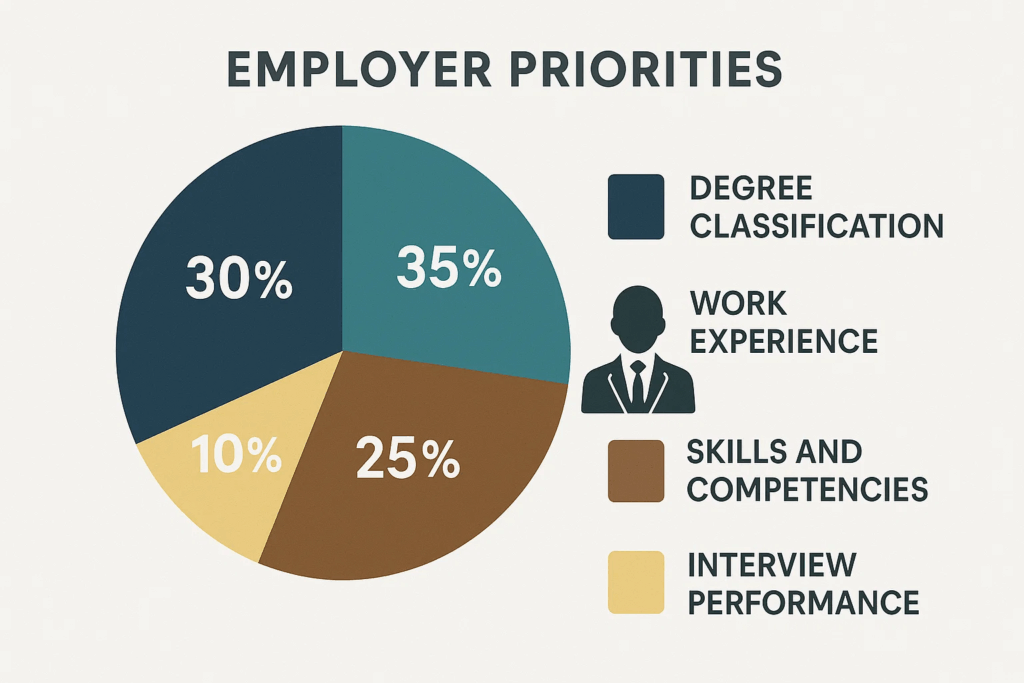
0-2 Years Post-Graduation: Degree class very important 3-5 Years Post-Graduation: Work experience gains equal weight 5+ Years Post-Graduation: Career achievements dominate 10+ Years Post-Graduation: Rarely mentioned unless in academia
Overcoming a 2.2 Classification
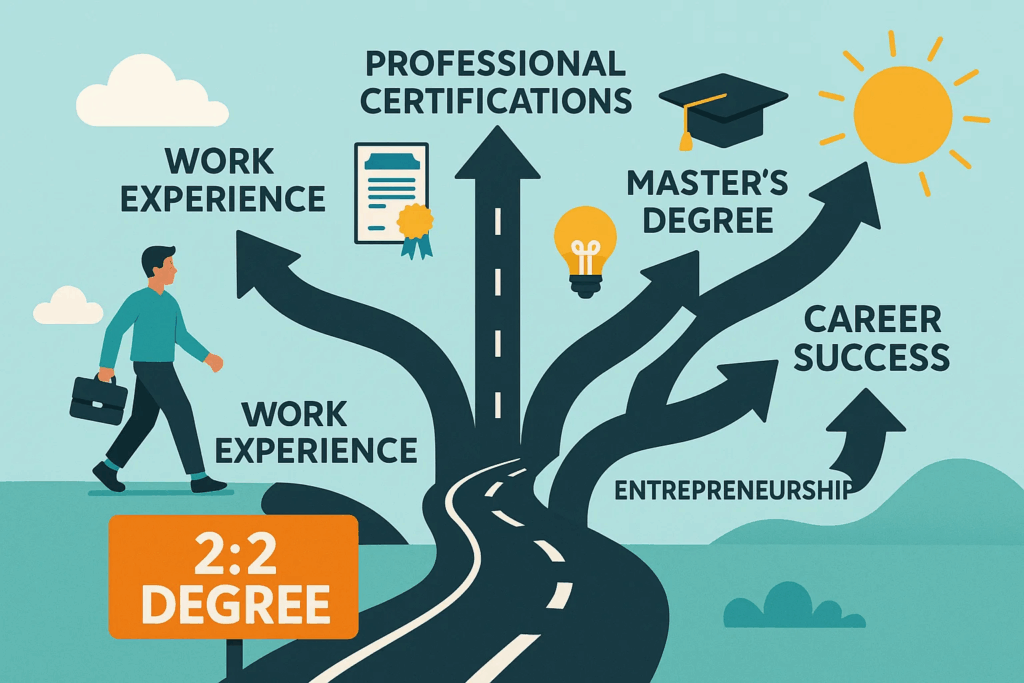
Successful 2.2 graduates compensate through:
Exceptional work experience during and after university
Strong professional networks and industry connections
Portfolio of achievements demonstrating capability
Compelling narrative explaining circumstances if applicable
Many successful professionals in fields like business management started with 2.2 degrees but built impressive careers through determination and strategic positioning.
How to Achieve a 2.1 Degree
Strategic Academic Planning
Achieving a 2.1 requires systematic approach from first year:
Year 1 – Foundation Building:
Understand assessment criteria and marking schemes
Develop strong study habits and time management
Build relationships with lecturers and tutors
Join study groups and academic societies
Aim for 65%+ in all modules
Year 2 – Skill Development:
Focus on critical analysis and research skills
Improve academic writing and referencing
Seek feedback on all assignments
Maintain consistent performance (60%+ minimum)
Consider opportunities that demonstrate engagement
Year 3 – Excellence Focus:
Prioritize dissertation or final project (often 40 credits)
Target 65-70% across all modules
Utilize all feedback and support services
Strategic module selection based on strengths
Maintain momentum through final assessments
Effective Study Techniques
For Essay-Based Subjects:
Critical analysis over description
Strong thesis statements and arguments
Wide reading beyond core texts
Proper academic referencing
Clear structure and logical flow
For Exam-Based Subjects:
Active recall and spaced repetition
Practice past papers under timed conditions
Understand mark schemes and examiner expectations
Develop concise, structured answers
Focus on understanding over memorization
For Practical/Project Work:
Early planning and time management
Regular supervisor meetings
Iterative improvement based on feedback
Professional presentation and documentation
Original thinking and innovation
Utilizing University Resources
Take advantage of:
Academic skills workshops
Writing centers and tutoring services
Peer-assisted learning schemes
Disability and wellbeing support
Library research support
Career services and mentoring programs
Can You Upgrade from a 2.2 to a 2.1?
During Your Degree
Borderline Consideration: If your final average falls between 58-60%, universities may:
Review your profile for extenuating circumstances
Consider upward trajectory in grades
Assess your final year performance specifically
Factor in strong performance in core modules
Account for external circumstances affecting performance
Academic Appeals: Valid grounds include:
Unrecorded extenuating circumstances
Administrative errors in grade calculation
Evidence of marking inconsistencies
Previously unreported health issues
After Graduation
Once awarded, degree classifications cannot be changed except through:
Entrepreneurial Path: Starting your own business circumvents degree class requirements entirely. Focus areas include:
Freelance consulting in your expertise area
E-commerce and online businesses
Service-based enterprises
Technology startups
Social enterprises
Real-World Success Stories
Notable Achievers with 2.2 Degrees
Business Leaders: Many successful CEOs and entrepreneurs graduated with 2.2 degrees, proving that determination and strategic career development matter more than initial classification.
Media Personalities: Several prominent journalists and broadcasters started with lower second-class degrees but built impressive careers through practical experience and networking.
Creative Industries: In fields like design, arts, and entertainment, portfolio quality and creative output often outweigh academic credentials.
Key Success Factors
Common traits among successful 2.2 graduates:
Resilience: Refusing to let classification define capability
Strategic Thinking: Finding alternative routes to goals
Continuous Learning: Pursuing development opportunities
Networking: Building strong professional relationships
Performance: Consistently delivering results in workplace
Adaptability: Pivoting when doors don’t immediately open
Frequently Asked Questions
Is the difference between 2.1 and 2.2 degrees really that significant?
Yes, particularly in the first 2-3 years after graduation. Many competitive employers and postgraduate programs use 2.1 as a screening criterion. However, this significance diminishes as you build work experience and professional achievements.
Can I get a good job with a 2.2 degree?
Absolutely. While some doors may initially be closed, many excellent career paths remain accessible. Focus on building strong work experience, developing in-demand skills, and targeting employers who value potential over credentials. The job-ready graduates concept emphasizes skills over classification.
Will I be able to do a Master’s degree with a 2.2?
Many universities offer routes to master’s study for 2.2 graduates, including pre-master’s programs, flexible entry requirements, and consideration of work experience. Research universities with more inclusive policies or consider distance learning options. Understanding what is an associate degree and other qualification pathways can also help.
How close is a 2.2 to a 2.1 in percentage terms?
Just 10 percentage points separate them (50-59% for 2.2 vs. 60-69% for 2.1). If you’re near the boundary (58-60%), discuss borderline consideration with your university.
Do employers really check degree classifications?
Yes, especially for graduate schemes and professional roles. However, as your career progresses, practical experience becomes more important than academic credentials.
What’s better: a 2.2 in a prestigious university or a 2.1 in a less prestigious one?
This depends on the industry and employer. Generally, a 2.1 from any accredited university is preferable for initial applications, but the reputation of your institution can provide networking advantages long-term.
How can I explain a 2.2 degree in job applications?
Be honest and focus on your strengths. If there were extenuating circumstances, mention them briefly. Emphasize what you learned from the experience, your work experience, skills, and achievements since graduation.
Can I retake my final year to improve my degree class?
This varies by university. Some institutions allow module resits or reassessment, but full year retakes are rare. Check your university’s regulations. Alternative routes like pursuing honours vs bachelor degree options might be more practical.
Conclusion: Your Degree Class Doesn’t Define Your Destiny
The difference between 2.1 and 2.2 degrees is real and measurable, particularly in the immediate aftermath of graduation. A 2.1 provides competitive advantages in graduate employment and postgraduate admissions that cannot be ignored. However, these classifications represent moments in time, not permanent judgments of your potential.
Key Takeaways:
✓ The 10-percentage-point gap creates significant initial career differences ✓ Strategic academic planning can help you achieve a 2.1 classification ✓ A 2.2 requires more strategic career navigation but doesn’t prevent success ✓ Work experience, skills, and achievements increasingly outweigh degree class over time ✓ Multiple pathways exist to overcome initial classification limitations ✓ Your long-term career success depends more on determination than credentials
Whether you’re currently studying and aiming for a 2.1, or you’ve graduated with a 2.2 and are planning your next steps, remember that honours degree types represent the starting line, not the finish line of your professional journey.
Your degree classification opens or closes certain doors initially, but your talent, work ethic, continuous learning, and resilience determine where you ultimately arrive. Focus on building transferable skills, gaining relevant experience, and creating opportunities that showcase your capabilities beyond academic credentials.
At London De International College, we understand that academic success comes in many forms. Whether you’re pursuing bachelor’s degree courses, considering postgraduate programs, or exploring professional qualifications, we provide flexible pathways tailored to your unique circumstances and career aspirations.
Ready to advance your education and career? Explore our comprehensive range of undergraduate and postgraduate programs designed for ambitious professionals. Contact London De International College today to discuss how we can support your academic and professional goals, regardless of your current academic standing.
Join London DE International College to unlock your potential and excel in today’s dynamic world. Our diverse range of programs is designed to equip you with the knowledge and skills needed to thrive in high-demand fields such as business, healthcare, IT, and language studies.