Navigating university options can be overwhelming, especially when encountering terms like “honors degree” with seemingly endless variations. Many students face confusion about how many types of honors degrees exist and which one might best serve their academic and career goals. This uncertainty can lead to misaligned educational choices that don’t maximize your potential or meet your career aspirations. In this comprehensive guide, we’ll explore the different types of honors degrees available in 2025, their unique characteristics, and how to determine which path aligns best with your academic strengths and professional ambitions.
What Exactly is an Honors Degree?
Before examining how many types of honors degrees exist, let’s clarify what makes a degree an “honors” qualification in the first place.
An honors degree is an undergraduate academic award that signifies a higher level of achievement and academic rigor than a standard or ordinary degree. Typically, honors degrees require:
More in-depth study of the subject matter
Higher academic standards and expectations
Independent research components (often including a dissertation or thesis)
Additional credits or a longer study period in some countries
The term “honors” (or “honours” in British English) indicates that the degree program maintains elevated academic standards and provides enhanced intellectual challenges for students. However, the specific meaning and structure of honors degrees vary significantly across different educational systems worldwide.
The 5 Main Types of Honors Degrees
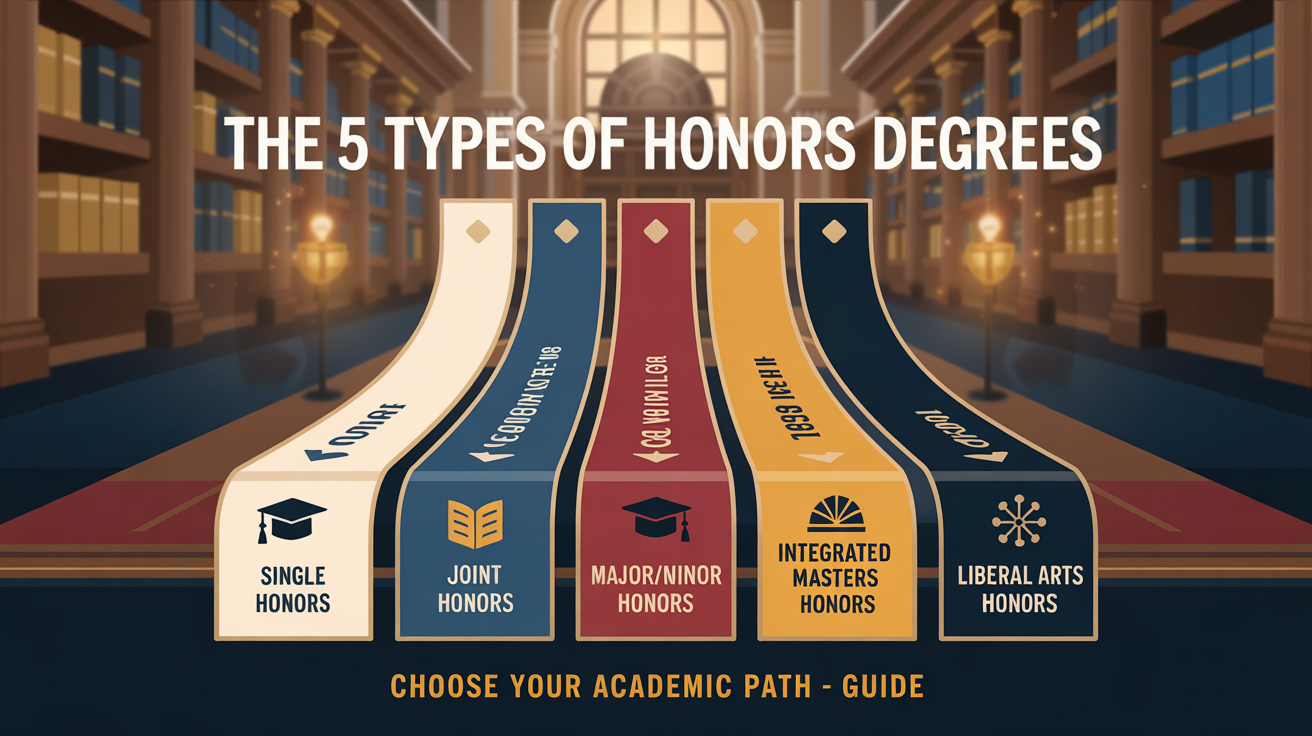
When exploring how many types of honors degrees exist, we can identify five primary categories that encompass most programs globally:
Single Honors Degrees: Focus on one main subject area
Joint Honors Degrees: Equal focus on two distinct academic disciplines
Major/Minor Honors Degrees: Primary focus on one subject with a secondary discipline
Integrated Masters Honors Degrees: Combined bachelor’s and master’s level study
Liberal Arts Honors Degrees: Broad, interdisciplinary education with an honors component
Each type offers distinct advantages and challenges, catering to different learning preferences and career trajectories. Let’s explore each in detail.
Single Honors Degrees: The Traditional Path
Single honors degrees represent the most common and traditional honors pathway, focusing intensively on one academic discipline throughout the duration of study.
Key Characteristics
Depth of Study: Comprehensive coverage of one subject area, exploring advanced concepts and specialized topics
Structure: Typically three years in the UK (four in Scotland) or four years in the US
Research Component: Usually includes a significant final-year project or dissertation
Specialization: Opportunity to develop subject matter expertise and specialized knowledge
Popular Single Honors Programs
BSc (Hons) in Computer Science
BA (Hons) in English Literature
BSc (Hons) in Psychology
BEng (Hons) in Mechanical Engineering
Ideal For
Single honors degrees best suit students with a clear passion for one subject who wish to develop deep expertise in a specific field. This approach particularly benefits those targeting careers requiring specialized knowledge or planning to pursue postgraduate research in the same discipline.
One graduate of a BSc (Hons) in Biology explained: “My single honors degree allowed me to explore every aspect of my field in remarkable depth. By my final year, I was working on research alongside academics that directly led to my current lab position.”
Joint honors degrees (sometimes called combined honors) allow students to study two different subjects with approximately equal weighting.
Key Characteristics
Equal Emphasis: Typically 50/50 split between two distinct disciplines
Interdisciplinary Skills: Development of versatile thinking across different academic approaches
Structure: Similar duration to single honors but with divided focus
Flexibility: Some programs allow adjusting the balance between subjects as you progress
Popular Joint Honors Combinations
BA (Hons) in History and Politics
BSc (Hons) in Mathematics and Economics
BA (Hons) in French and Business
BSc (Hons) in Computer Science and Philosophy
Ideal For
Joint honors degrees suit students with strong interests in two distinct fields who don’t want to sacrifice either passion. These programs particularly benefit those seeking careers in emerging interdisciplinary fields or roles requiring versatility across different knowledge domains.
As one joint honors graduate noted: “My Economics and Spanish degree gave me a competitive edge when applying for international business roles. I understand both the financial models and the cultural nuances of Spanish-speaking markets.”
Major/Minor Honors Degrees: Focused with Complementary Skills
Major/Minor honors degrees provide a primary focus on one subject while allocating a smaller portion of study time to a secondary discipline.
Key Characteristics
Weighted Distribution: Typically follows a 75/25 or 70/30 split between major and minor subjects
Primary Expertise: Develops depth in the major subject comparable to single honors
Complementary Knowledge: Adds valuable skills or perspectives from the minor subject
Structure: Similar overall duration to other honors programs
Popular Major/Minor Combinations
BA (Hons) in English with Creative Writing
BSc (Hons) in Physics with Mathematics
BA (Hons) in Business with a Minor in Mandarin Chinese
BSc (Hons) in Computer Science with Data Science
Ideal For
Major/Minor honors degrees suit students with a clear primary academic interest who want to enhance their prospects with complementary skills. This approach particularly benefits those seeking to differentiate themselves in competitive job markets or whose career goals cross disciplinary boundaries.
“My Psychology major with Statistics minor gave me both the theoretical understanding of human behavior and the quantitative skills to analyze research data,” explained one recent graduate now working in market research.
Integrated Masters Honors Degrees: Undergraduate to Postgraduate
Integrated Masters honors degrees combine undergraduate and postgraduate study into a single, extended program.
Key Characteristics
Extended Duration: Typically four years in the UK (five in Scotland) or five years in some other systems
Progressive Difficulty: Transitions from undergraduate to masters-level work
Advanced Research: Includes substantial independent research components
Qualification Level: Results in both an honors bachelor’s and a masters qualification
Common Integrated Masters Programs
MEng (Hons) – Master of Engineering
MChem (Hons) – Master of Chemistry
MPhys (Hons) – Master of Physics
MMath (Hons) – Master of Mathematics
Ideal For
Integrated Masters honors degrees suit academically strong students committed to their discipline who want to streamline their path to an advanced qualification. These programs particularly benefit those planning careers in research, specialized technical roles, or fields where a masters-level qualification provides a significant advantage.
“My integrated MEng meant I could progress smoothly from undergraduate to masters-level engineering without interruption,” said one graduate now working in aerospace design. “The continuity allowed me to develop a more sophisticated final project that directly impressed my current employer.”
Liberal Arts Honors Degrees: Breadth and Flexibility
Liberal Arts honors degrees provide a broad, interdisciplinary education with honors-level academic expectations and opportunities.
Key Characteristics
Interdisciplinary Focus: Spans humanities, social sciences, and sometimes natural sciences
Flexibility: Students often design significant portions of their curriculum
Critical Thinking: Emphasis on analytical skills and intellectual development
Honors Components: Special seminars, advanced coursework, and culminating projects
Program Examples
BA (Hons) Liberal Arts
BA (Hons) Interdisciplinary Studies
BA (Hons) Liberal Studies with Humanities Concentration
BA (Hons) Combined Studies
Ideal For
Liberal Arts honors degrees suit intellectually curious students who value breadth of knowledge and transferable skills over early specialization. These programs particularly benefit those interested in careers requiring adaptability, critical thinking, and communication across different domains of knowledge.
“My Liberal Arts honors degree allowed me to combine philosophy, politics, and economics while maintaining the rigor of an honors program,” explained one graduate now working in public policy. “I developed a unique intellectual framework that helps me approach complex problems holistically.”
Beyond the types of honors degrees based on subject configuration, it’s important to understand the classification system that indicates the level of academic achievement within honors programs.
In the UK and many Commonwealth countries, honors degrees are classified as:
Classification
Typical Percentage Range
Description
First Class (1st)
70%+
Highest level of achievement
Upper Second Class (2:1)
60-69%
Strong academic performance
Lower Second Class (2:2)
50-59%
Satisfactory honors performance
Third Class (3rd)
40-49%
Minimum honors classification
In the US and some other countries, honors distinctions often follow this pattern:
Summa Cum Laude: Highest honors (typically top 1-5% of graduates)
Magna Cum Laude: High honors (typically top 10-15% of graduates)
Cum Laude: Honors (typically top 20-30% of graduates)
These classifications appear on your degree certificate and transcript, providing employers and graduate schools with a standardized measure of your academic achievement.
International Differences in Honors Degree Types
When considering how many types of honors degrees exist globally, it’s important to recognize significant variations between educational systems:
United Kingdom System
Clear distinction between honors and ordinary degrees
Typically three-year duration (four in Scotland)
Classified by achievement level (First, 2:1, 2:2, Third)
Strong emphasis on final-year performance
United States System
Honors often refers to achievement level rather than program type
May involve participating in a specialized “honors college” within a university
Typically four-year duration
Latin honors designations based on GPA (Cum Laude, etc.)
Often includes honors thesis requirement
Australian System
Similar to UK with classifications based on achievement
May offer “Honours” as an additional year after a standard bachelor’s
Strong research component in the honors year
European Systems
Varies significantly between countries
Bologna Process has standardized some aspects of honors education
May not use the term “honors” but have equivalent concepts
Understanding these differences is essential when comparing international qualifications or considering studying abroad.
How to Choose the Right Honors Degree Type
With so many types of honors degrees available, selecting the right path requires careful consideration of several factors:
1. Assess Your Academic Interests
Do you have one clear passion or multiple strong interests?
Are you certain about your academic direction or still exploring?
Do you prefer depth in one area or versatility across disciplines?
2. Consider Your Learning Style
Do you thrive when focusing intensively on one subject?
Do you enjoy making connections between different fields?
Do you prefer structured programs or more flexible curricula?
3. Evaluate Career Goals
Research qualification requirements for your target careers
Consider which degree type offers the most relevant preparation
Investigate which skills will differentiate you in your chosen field
4. Practical Considerations
Compare course content across different program types
Evaluate institutional strengths in relevant subject areas
Consider opportunities for internships, study abroad, or industry connections
Decision-Making Framework
Ask yourself these key questions:
“Am I confident enough in my choice of subject to commit to a single honors degree?”
“Will combining subjects enhance my career prospects in my chosen field?”
“Do I need the advanced qualification of an integrated masters?”
“Would I benefit more from specialized knowledge or interdisciplinary versatility?”
Remember that many universities offer opportunities to adjust your path during the first year if your initial choice doesn’t feel right.
Application Requirements for Different Honors Types
Application criteria often vary between different types of honors degrees:
Single Honors Application Requirements
Strong academic record in the relevant subject area
Personal statement demonstrating subject passion and understanding
Often requires specific A-level subjects or prerequisite courses
May require portfolio or audition for creative disciplines
Joint Honors Application Requirements
Competitive grades in both subject areas
Personal statement addressing both disciplines and their connections
May require meeting entry criteria for two different departments
Often values evidence of time management and versatility
Integrated Masters Application Requirements
Typically higher entry requirements than standard honors programs
Strong performance in relevant prerequisite subjects
Convincing statement about long-term academic or research ambitions
May require interview for selection
Liberal Arts Honors Application Requirements
Strong overall academic profile across multiple subjects
Articulate personal statement demonstrating intellectual curiosity
Often values extracurricular achievements and diverse interests
May include interview to assess critical thinking abilities
Understanding these differences can help you tailor your application strategy to maximize chances of admission to your preferred program type.
Career Implications of Different Honors Degree Types
Different types of honors degrees can influence your career trajectory in various ways:
Single Honors Career Advantages
Clear qualification for specialized roles
Established pathway to related postgraduate study
Deep expertise valued in research positions
Strong foundation for progression within a specific industry
Joint Honors Career Advantages
Versatility for roles spanning multiple sectors
Distinctive profile that sets you apart from other candidates
Adaptability to emerging interdisciplinary fields
Transferable skills applicable across different career paths
Major/Minor Career Advantages
Primary qualification with valuable supplementary skills
Competitive edge in specialized roles requiring specific secondary knowledge
Flexibility to pivot between related career paths
Distinctive combination that can address specific industry needs
Integrated Masters Career Advantages
Advanced qualification without interrupting academic momentum
Competitive advantage for senior technical or research positions
Often preferred for international recognition
May satisfy professional accreditation requirements more efficiently
According to a 2024 employability study, while all honors degree types show strong employment outcomes, differences emerge in career progression patterns. Single honors graduates often advance faster in specialized technical roles, while joint honors graduates show greater career adaptability and more frequent successful sector changes.
FAQs About Types of Honors Degrees
Are certain types of honors degrees considered more prestigious than others?
The prestige of a degree depends more on the institution, your classification (First, 2:1, etc.), and the relevance to your career field than on whether it’s single, joint, or another honors type. All legitimate honors degrees represent significant academic achievement.
Can I switch between different types of honors degrees after starting university?
Many universities allow switches between single and joint honors programs during the first year, though policies vary. Switching to or from integrated masters typically depends on academic performance. Always check specific institutional policies.
Do employers prefer certain types of honors degrees?
Employer preferences depend entirely on the sector and role. Technical and scientific positions often favor single honors or integrated masters in relevant disciplines, while sectors valuing versatility (like media, business, or public policy) may appreciate joint or liberal arts honors degrees.
How does the dissertation or thesis requirement differ between honors types?
Single honors dissertations typically explore one discipline in depth. Joint honors students usually choose to focus their dissertation on one of their subjects or pursue an interdisciplinary topic. Integrated masters require more advanced research projects, often with greater independence.
Are there differences in teaching methods between honors degree types?
Single honors programs typically follow consistent teaching approaches within one department. Joint honors students experience different teaching methods across departments. Liberal arts honors often feature more discussion-based seminars. Integrated masters progressively shift toward independent research.
How do international universities view different UK honors degree types?
Most international universities recognize all types of UK honors degrees, focusing more on the institution’s reputation and your classification than the specific honors type. However, for specialized postgraduate programs, relevant single honors or integrated masters degrees may have an advantage.
Conclusion
Understanding how many types of honors degrees exist and their distinct characteristics is essential for making informed educational choices. Whether you thrive on the depth of single honors, the versatility of joint honors, the strategic combination of major/minor, the advanced study of integrated masters, or the breadth of liberal arts honors, each path offers unique advantages for different learning styles and career aspirations.
The ideal honors degree type aligns with your academic strengths, intellectual curiosities, and professional goals. By carefully evaluating these factors alongside the specific offerings of different universities, you can select an honors program that provides both academic fulfillment and career preparation.
As the employment landscape continues to evolve, employers increasingly value both specialized expertise and interdisciplinary versatility. All honors degree types can lead to successful outcomes when chosen thoughtfully and pursued with dedication. The key is matching your choice to your personal strengths and ambitions rather than following prescribed paths.
Ready to explore specific honors degree options? Contact our advisors at London de International to discuss how our diverse program offerings can align with your academic interests and career goals.
Unlock Your Career Growth
Join London DE International College to unlock your potential and excel in today’s dynamic world. Our diverse range of programs is designed to equip you with the knowledge and skills needed to thrive in high-demand fields such as business, healthcare, IT, and language studies.