Are you questioning whether an associate degree is truly worth your time and investment? You’re standing at a crucial crossroads, watching peers debate between jumping straight into bachelor’s programs or taking what some dismiss as a “shorter route.” The fear of making the wrong choice keeps you up at night—what if you invest two years only to find employers dismissing your qualification? What if you’re left behind while others with four-year degrees accelerate past you? Here’s the reality: an associate degree can be your strategic advantage, offering faster career entry, significant cost savings, and flexible pathways to advancement—if you understand how to leverage it effectively.
Understanding What an Associate Degree Really Offers
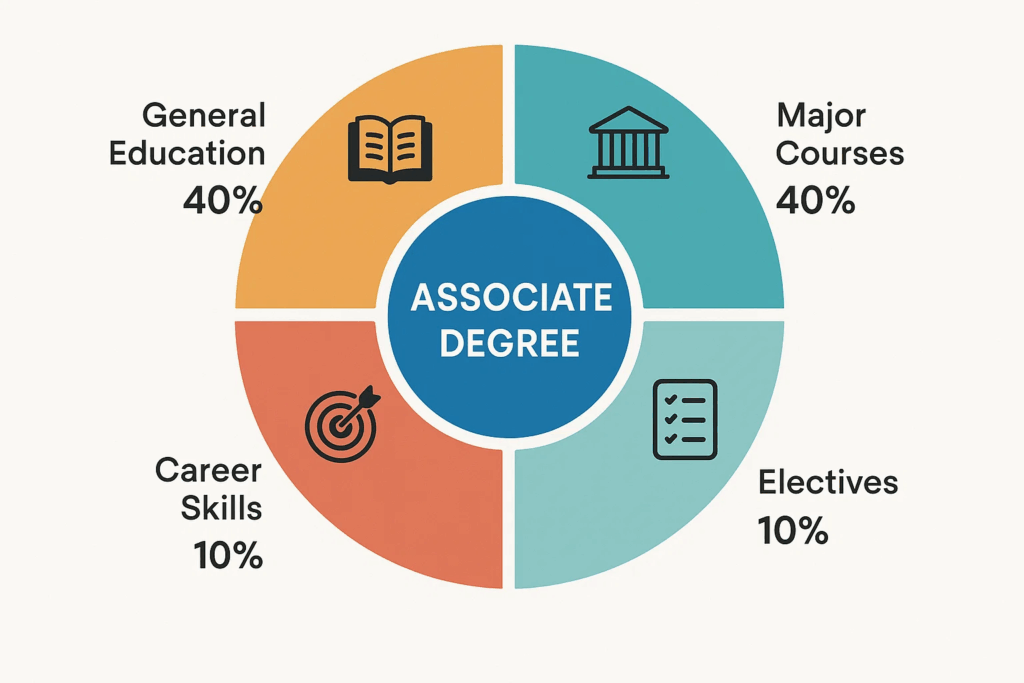
An associate degree represents a two-year post-secondary credential that bridges the gap between high school education and advanced career opportunities. Unlike quick certificate programs, associate degrees provide comprehensive foundational knowledge in specific fields while maintaining the flexibility that modern students demand.
These programs typically require 60-70 credit hours and come in several formats:
Associate of Arts (AA): Humanities and liberal arts focus
Associate of Science (AS): Mathematics and science concentration
Associate of Applied Science (AAS): Career-technical education
Associate of Business Administration (ABA): Business fundamentals
The flexibility of associate degree programs allows students to balance work, family commitments, and education simultaneously—a critical advantage in today’s fast-paced world.
The Financial Reality: Cost-Benefit Analysis
When examining whether is associate degree worth it, the financial equation becomes compellingly clear. The average associate degree costs between $3,800-$10,000 per year, compared to bachelor’s programs that can exceed $35,000 annually at private institutions.
Cost Comparison Breakdown
Associate Degree Investment:
Tuition: $7,600-$20,000 (total)
Books and supplies: $2,000-$3,000
Opportunity cost: 2 years
Total investment: $10,000-$25,000
Bachelor’s Degree Investment:
Tuition: $40,000-$140,000 (total)
Books and supplies: $4,000-$5,000
Opportunity cost: 4 years
Total investment: $45,000-$150,000
The advantages of associate degree programs extend beyond just tuition savings. Students can begin earning in their chosen field two years earlier, creating a cumulative financial advantage that compounds over time.
Key Financial Benefits:
Lower student debt: Average associate degree holders carry $17,000 in debt versus $37,000 for bachelor’s degree holders
Faster earning potential: Begin professional salary 2 years earlier
Employer tuition assistance: Many companies offer education benefits after hire
Reduced living expenses: Shorter program duration minimizes accommodation costs
Career Opportunities with an Associate Degree
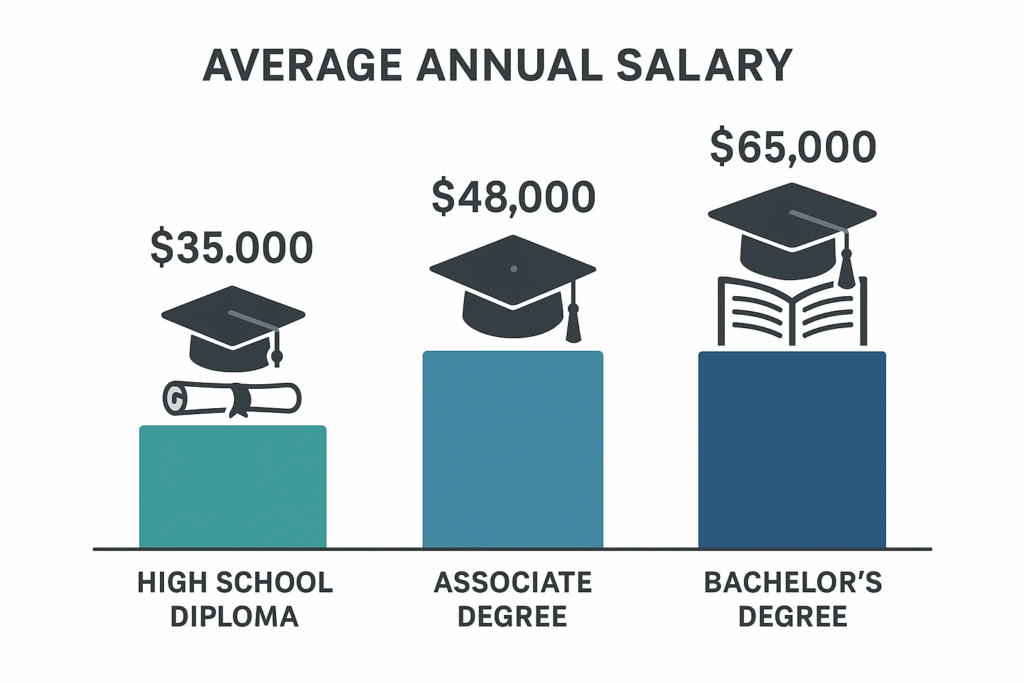
The question “is associate degree worth it” finds its most practical answer in career outcomes. According to 2024 labor statistics, associate degree holders earn 38% more than high school graduates, with median annual earnings of $48,000 compared to $35,000.
High-Demand Fields for Associate Degree Holders
Healthcare Sector:
Registered Nurse (RN): $77,600 median salary
Dental Hygienist: $79,000 median salary
Radiologic Technologist: $63,000 median salary
Respiratory Therapist: $68,000 median salary
Technology Sector:
Network Administrator: $62,000 median salary
Web Developer: $58,000 median salary
Computer Support Specialist: $55,000 median salary
Database Administrator: $65,000 median salary
Business & Finance:
Accounting Technician: $45,000 median salary
Paralegal: $56,000 median salary
Human Resources Specialist: $52,000 median salary
Skilled Trades:
Engineering Technician: $58,000 median salary
Electrical Technician: $62,000 median salary
HVAC Technician: $53,000 median salary
The benefits of pursuing HND programs—a UK equivalent to associate degrees—demonstrate similar career advancement opportunities in international markets.
Is Associate Degree Worth It Compared to a Bachelor’s?
Immediate Career Entry: Associate degrees prioritize job-ready skills over theoretical knowledge. Students graduate with hands-on experience and industry certifications that employers immediately value.
Career Pivot Opportunities: For professionals seeking career changes, two years represents a manageable commitment compared to returning for a full four-year program.
Industry Certification Alignment: Many associate programs integrate industry certifications (CompTIA, Microsoft, Cisco) directly into curricula, providing dual credentials.
Geographic Flexibility: Regional demand for skilled workers often values associate credentials equally to bachelor’s degrees in technical fields.
When Bachelor’s Degrees Have Advantage
Management Positions: Upper-level management roles typically require bachelor’s degrees as minimum qualifications.
Specialized Professional Fields: Engineering, architecture, and licensed professions mandate four-year degrees.
Research and Development: Advanced technical research positions prefer bachelor’s or higher degrees.
Salary Ceiling: Long-term earning potential generally favors bachelor’s degree holders, with median lifetime earnings $900,000 higher.
The key insight: is associate degree worth it depends entirely on your career goals, financial situation, and timeline.
Industry-Specific Value of Associate Degrees
Healthcare Industry
The healthcare sector offers exceptional ROI for associate degree holders. Nursing programs, specifically, create direct pathways to registered nurse positions commanding competitive salaries. The nursing shortage across developed nations ensures strong job security and advancement opportunities.
Career Progression Example:
Year 0-2: RN with Associate Degree ($77,600)
Year 3-5: RN with BSN (online completion) ($85,000)
Year 6+: Nurse Practitioner or Specialization ($110,000+)
Technology employers increasingly prioritize demonstrable skills over formal education credentials. An associate degree in IT, combined with industry certifications, often proves sufficient for entry-level positions.
Technology Career Path:
Help Desk Technician → Network Administrator → Systems Engineer
Web Developer → Full Stack Developer → Development Manager
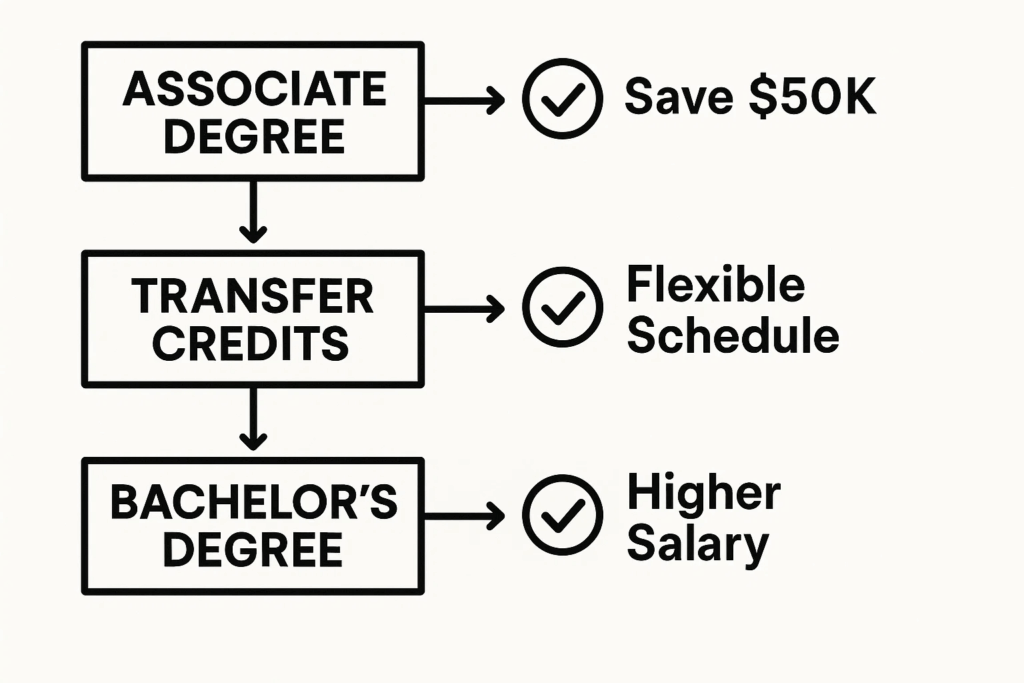
Perhaps the most strategic answer to “is associate degree worth it” lies in the transfer pathway model. This approach minimizes financial risk while maximizing educational options.
The 2+2 Model
Complete an associate degree at a community college (2 years), then transfer to a university for junior and senior years (2 years). This strategy delivers:
Financial Benefits:
Save $30,000-$50,000 on first two years
Same bachelor’s degree as four-year students
Reduced student loan burden
Academic Benefits:
Smaller class sizes in early years
More personalized attention from instructors
Solid academic foundation before university transfer
Proven academic capability reduces transfer rejection
Strategic Considerations:
Verify articulation agreements between institutions
Maintain required GPA for transfer (typically 2.5-3.0)
Complete general education requirements strategically
Year 1-2: Associate Degree in Nursing (Total cost: $18,000)
Year 3-5: Working as RN while completing online BSN
Earnings during BSN: $235,000 (gross)
Year 6: Promoted to Charge Nurse ($92,000 annually)
Total ROI: 1,200% within 6 years
Technology Career Transformation
Michael’s Path:
Career change at age 30
Associate Degree in IT (Total cost: $15,000)
Entry position: Help Desk ($45,000)
Year 3: Network Administrator ($62,000)
Year 5: Systems Engineer ($85,000)
Career transformation in 5 years with minimal debt
Business Administration Growth
Priya’s Strategy:
Associate in Business Administration
Entry role: Administrative Coordinator ($42,000)
Employer-funded bachelor’s completion
Year 4: Operations Manager ($68,000)
Zero additional education debt
These examples demonstrate that when asking is associate degree worth it, the answer often depends on strategic planning and execution rather than the credential alone.
Making Your Decision: Key Factors to Consider
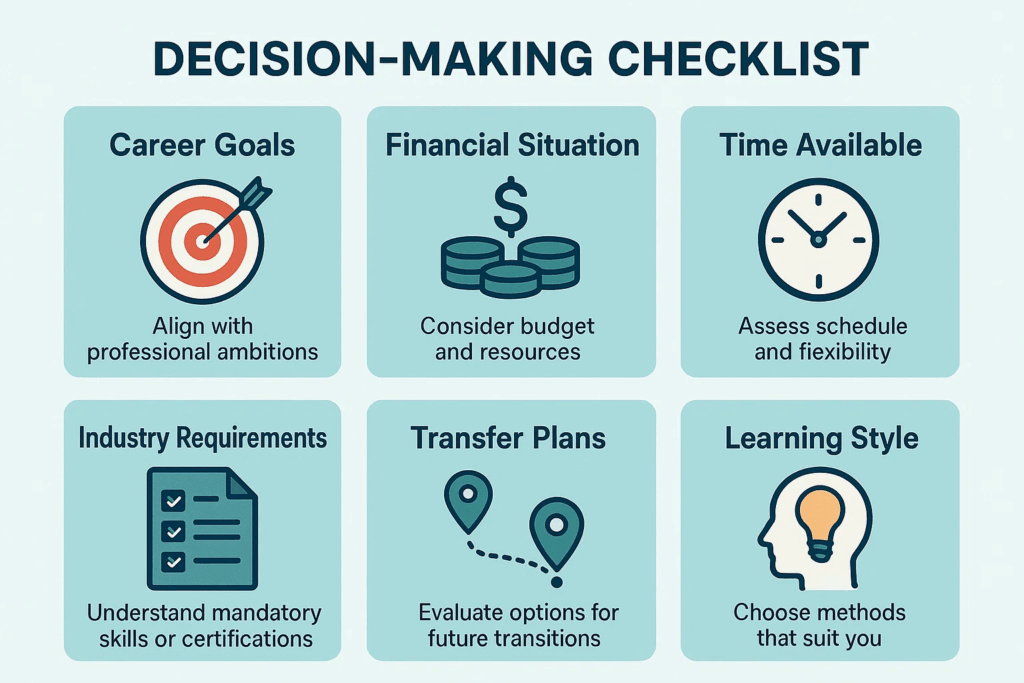
Assessment Framework
1. Career Clarity
Do you have specific career goals requiring associate credentials?
Have you researched job postings in your target field?
Do employers in your region value associate degrees?
2. Financial Analysis
Can you afford the program without excessive debt?
What is your opportunity cost of not working full-time?
Are scholarships, grants, or employer sponsorships available?
3. Timeline Considerations
Do you need to enter the workforce quickly?
Can you commit to a longer bachelor’s program?
Are family obligations a factor in your timeline?
4. Transfer Intentions
Do you plan to continue to a bachelor’s degree?
Have you identified transfer-friendly institutions?
Are articulation agreements in place?
5. Learning Preferences
Do you prefer practical, hands-on learning?
Does theoretical coursework engage you?
Would you benefit from smaller class environments?
Yes, particularly in healthcare, technology, and skilled trades where employer demand exceeds qualified candidate supply. The key is selecting in-demand fields with clear career progression.
Can you get a good job with just an associate degree?
Absolutely. Registered nurses, dental hygienists, web developers, and network administrators with associate degrees earn comfortable middle-class incomes with strong job security.
How long does an associate degree take?
Typically 2 years of full-time study or 3-4 years part-time. Accelerated programs may allow completion in 18 months, while working professionals might take longer.
Will employers respect my associate degree?
In practical fields like healthcare, IT, and business, employers value demonstrated skills and certifications. Associate degrees combined with relevant experience command respect across industries.
Can I transfer my associate degree credits?
Most accredited associate degrees transfer to bachelor’s programs, especially when articulation agreements exist between institutions. Verify transfer policies before enrolling.
What’s the salary difference between associate and bachelor’s degrees?
Bachelor’s degree holders earn approximately $17,000 more annually on average, but this varies significantly by field. Healthcare associate degree holders often out-earn bachelor’s holders in other fields.
Final Verdict: When an Associate Degree Makes Sense
After examining financial data, career outcomes, and strategic pathways, is associate degree worth it? The answer is a resounding yes—under specific circumstances:
Pursue an Associate Degree When:
You have clear career goals in high-demand technical fields
Financial constraints make bachelor’s programs challenging
Quick workforce entry is your priority
You plan to transfer and want to minimize costs
Practical skills matter more than theoretical knowledge in your field
Employer sponsorship is available for continued education
Geographic location has strong demand for associate-credentialed professionals
Consider Bachelor’s Programs When:
Management or leadership roles are immediate goals
Your chosen field legally requires four-year credentials
Financial aid makes bachelor’s programs affordable
Research or theoretical work interests you
Maximum lifetime earning potential is your priority
The Hybrid Strategy
The most strategic approach often combines both: complete an associate degree, gain work experience, allow employers to fund bachelor’s completion. This method minimizes debt while maximizing career flexibility and earning potential.
Understanding options like how many years bachelor degree programs require helps students plan comprehensive educational strategies that align with personal goals and circumstances.
Take Action: Your Next Steps
If you’ve determined an associate degree aligns with your goals:
Step 1: Research Programs
Identify accredited institutions in your area
Compare program costs and curricula
Verify industry certification integration
Check transfer articulation agreements
Step 2: Financial Planning
Complete FAFSA for federal aid eligibility
Research institutional scholarships
Explore employer tuition assistance programs
Calculate total program costs including supplies
Step 3: Career Mapping
Connect with professionals in target fields
Review job postings for required qualifications
Identify skills gaps you need to address
Plan certification timeline alongside degree
Step 4: Application Preparation
Gather transcripts and test scores
Prepare personal statements
Secure recommendation letters
Meet application deadlines
The question “is associate degree worth it” ultimately has a personalized answer. For students seeking practical skills, quick workforce entry, and cost-effective education, associate degrees represent strategic investments in your future. For those requiring specialized knowledge, management track positions, or maximum earning potential, bachelor’s degrees may prove more appropriate.
The key to success lies not in the credential itself, but in strategic selection, dedicated execution, and continuous learning throughout your career journey.
Ready to make an informed decision about your education? Connect with London De International College to explore how our internationally recognized programs can accelerate your career success while maintaining flexibility and affordability.
Unlock Your Career Growth
Join London DE International College to unlock your potential and excel in today’s dynamic world. Our diverse range of programs is designed to equip you with the knowledge and skills needed to thrive in high-demand fields such as business, healthcare, IT, and language studies.